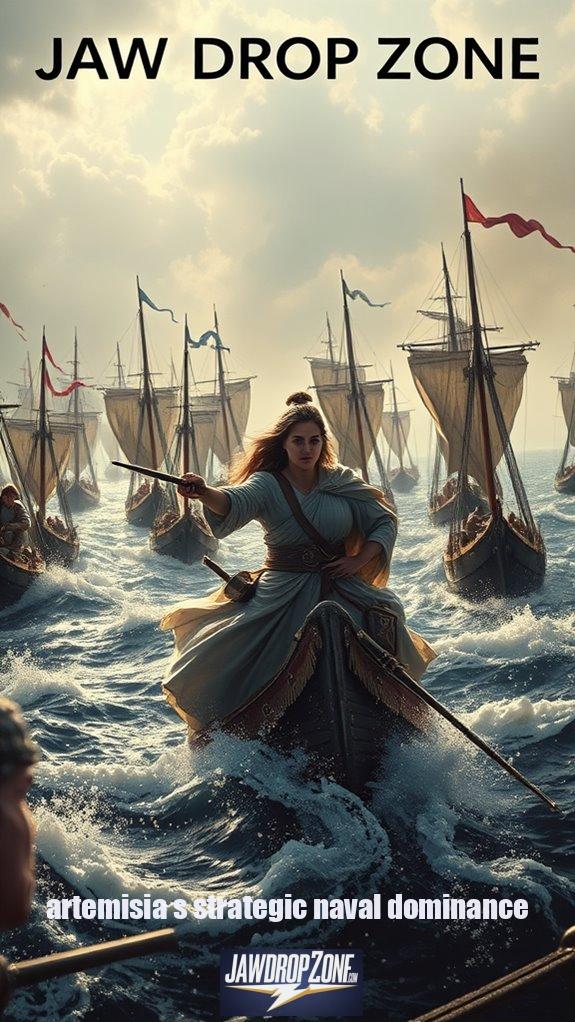
Have you ever wondered how a single brilliant mind could outmaneuver an entire fleet? Queen Artemisia’s tactics at the Battle of Salamis were nothing short of genius! She turned narrow straits to her advantage, lured the Persians into traps, and mastered the art of ramming—who knew close-quarters combat could be so exhilarating? This battle revealed that retreat can be just as strategic as advancing. Intrigued? There’s so much more to uncover about her legendary command!
Quick Takeaways
- Utilize terrain effectively to control battle dynamics, minimizing the enemy’s numerical advantage and exploiting narrow straits for tactical gain.
- Implement deceptive tactics such as feigned retreats to lure the enemy into unfavorable positions, disrupting their formations.
- Master ramming techniques for impactful engagements, focusing on precise strikes to disable opponents without sinking vessels.
- Create chaos within enemy lines, using targeted strikes to exploit their disarray, demonstrating strategic finesse over brute force.
- Recognize the importance of retreat as a strategic option, leveraging feigned vulnerability to draw adversaries into traps for long-term advantage.
Understanding the Terrain at Salamis

When you think of epic battles, what comes to mind?
Picture the straits of Salamis, where the narrow waters turned the tide of history. It’s fascinating how the only mile-wide gap shaped the fate of thousands.
Imagine heavy Greek ships, their massive hulls dominating those lighter Persian vessels, packed in like sardines. You’d think numbers guarantee victory, right? Wrong! The Greeks wove their strategy around the terrain, using those tight confines to dismantle the Persian superiority. The Persians’ motivation to engage drove them to attack the Greeks within those narrow confines, despite their initial advantage in numbers.
Heavy Greek ships turned the tide in narrow waters, proving that strategic terrain beats numbers in epic battles.
Plus, let’s not forget the winds! Those fickle breezes didn’t just add drama; they skewed the balance, making Greek ships far more stable. The mountains, ruthless guardians of the strait, left the Persians with limited escape routes. Talk about being trapped!
It’s astonishing how geography not only influences battles but can turn the predictable into the unpredictable.
That’s why I created Jaw Drop Zone—so we could dig deeper into these overlooked gems of history!
The Power of Luring Tactics

The Salamis battle wasn’t just about ship sizes or brute force; it was a masterclass in strategy, particularly the genius of luring tactics.
Envision the scene: the Greeks feigned a retreat, tempting the mighty Persians into the tight confines of the Salamis Straits. What happened next? Their numerical advantage vanished like a mirage in the desert!
Led by the brilliant Themistocles, this cunning play neutralized the invaders in those narrow waters, turning the tide of the war. Who knew a well-timed trick could be the difference between victory and defeat?
In a world where one wrong move could spiral into chaos, these lures showed that deception could be as powerful as brute strength.
It’s an essential lesson, right? Sometimes, finesse trumps force. For more engaging stories from ancient strategies, check out Jaw Drop Zone, where we explore tactics that still shock and inspire!
Strategic Adaptation to Opponent Capabilities

Strategic adaptation to an opponent’s capabilities often feels like a high-stakes game of chess on water, right?
Picture steering through the treacherous Straits of Salamis, your smaller fleet cleverly using constricted areas to counteract the Persians’ imposing numbers.
It’s both art and science—understanding currents and winds to turn the tide in your favor.
Ever thought about how the design of enemy ships can be your secret weapon?
The colossal Persian vessels, mighty in open water, struggle in narrow paths. By recognizing this, you can exploit their weaknesses—glorious victories await!
With a keen eye, I’ve learned to design tactics that bend their strengths against them and remain flexible to adapt.
Mastering the art of strategy means twisting your opponent’s strengths into their own downfall while staying adaptable for any challenge ahead.
This website, Jaw Drop Zone, is all about revealing such dazzling strategies, ensuring you reign supreme on any battlefield.
Moreover, many of the great victories were often aided by royal women’s diplomatic involvement, showcasing the power of strategic negotiation alongside military prowess.
Emphasizing Ramming as a Combat Technique

Envision this: you’re a commander in the tumultuous waters of Salamis, adrenaline pumping as you prepare for the clash. Your eyes scan the horizon, knowing that ramming can be your secret weapon. But why?
Ramming wasn’t just a tactic; it was art. The evolution of naval rams from flimsy hindsight to effective boar’s head designs demonstrated our engineering prowess. They could disable a ship without sinking it—how’s that for strategic finesse?
Imagine executing the diekplous, skillfully sliding between enemy vessels to deliver a thunderous blow with precision and terrifying effect.
And let’s face it; ramming beats struggling with pesky boarders who want to commandeer your ship.
Here’s the kicker: these tactics didn’t vanish. They thrived, even popping back up in the steam era!
The Role of Boarding Actions in Naval Warfare

While many might think naval warfare boils down to big guns and sleek hulls, the truth is that boarding actions were often the heart-pounding climax of sea battles.
Imagine a narrow strait, ships practically touching—this scene was perfect for chaos. Ancient Greeks and Persians used swift galleys to board rival vessels, while Romans flaunted their corvus, a clever ramp that turned the tide of battle.
It wasn’t just about cannons; those grappling hooks? Essential for a smooth takeover.
As heavy artillery evolved, boarding became less frequent yet still relevant—pirates thrived on it. Ever think about how a simple boarding could capture a ship without a scratch?
Chaotic, close-quarters combat ruled the day, where every swing of a sword counted!
I created Jaw Drop Zone to explore these breathtaking twists in history.
Creating Distractions for Enemy Disruption

Creating distractions in naval warfare might sound like a trick pulled straight from a magician’s hat, but trust me—it was all about cunning and creativity on the high seas.
Picture it: battle-hardened fleets maneuvering with flair.
Here’s how Artemisia pulled it off:
- Utilizing Flags for Misdirection: She cleverly flew Greek and Persian flags, making enemies unsure if they faced a friend or foe.
- Exploiting Channels to Delay Movements: The narrow straits at Salamis allowed Greeks to delay the mighty Persian forces, keeping them out of sync.
- Dynamic Naval Maneuvers: Rapid shifts in strategy disrupted enemy formations, leaving them bewildered and vulnerable.
Isn’t it fascinating how deceptive tactics can turn the tide?
If you crave more jaw-dropping revelations into ancient naval tactics, you’ll find them here at Jaw Drop Zone.
It’s about time we understood the art of distraction on the water!
The Art of Deception in Naval Strategy

In the churning waters of naval strategy, deception isn’t just a clever trick—it’s a game-changer that can rewrite the rules of engagement.
Seriously, have you ever considered how a feint can alter the trajectory of an entire battle?
Take Operation Fortitude, for instance. Allied forces staged a phony invasion, fooling the Germans and securing victory with the element of surprise.
It’s like playing chess but with an invisible queen!
Concealment is another brilliant tactic. By hiding true operations behind misleading maneuvers, you can keep your enemies guessing.
Their cognitive biases become your playthings, and that’s where the fun begins.
As I share these revelations through my website, Jaw Drop Zone, keep in mind: knowledge is power.
The art of deception isn’t just about outsmarting; it’s about seizing control.
Targeting Key Enemy Elements for Maximum Impact

Targeting key enemy elements isn’t just a tactical choice; it’s an art form that can turn the tide of battle in the blink of an eye. Imagine this: the Greeks, with their keen intuition, knew exactly where to strike the Persian fleet.
- Identifying Weak Ships: They focused on the vulnerable vessels, hitting them where it hurt the most.
- Disruption of Enemy Formations: Breaking the enemy line transformed chaos into opportunity, making their disarray a tactical advantage.
- Taking Out Command Ships: Removing command vessels diabolically snuffed out Persian coordination, leaving them floundering.
Do you see the beauty in orchestrating such chaos? By artfully targeting these elements, the Greeks didn’t just fight; they danced upon the battlefield, ensuring victory at Salamis.
It’s fascinating, isn’t it? Discovering these tactics is what this site, Jaw Drop Zone, is all about—unraveling the secrets that can elevate our understanding of strategy.
Adapting Naval Operations to Weather Conditions

Weather can turn the calmest seas into raging tempests, yet naval commanders throughout history have always embraced the elements with cunning and adaptability.
Envision sailing full steam ahead, only to find yourself at the mercy of a storm—how would you hold your ground?
By mastering the concept of the “weather gage,” you can seize the upper hand. When you’re upwind, you control the battle’s tempo, press the attack, or retreat as needed.
But if you’re caught leeward? Good luck trying to force a battle while dodging enemy fire.
Consider the Romans, who lost entire fleets in storms during the First Punic War. That disaster was a harsh wake-up call about the risks of ignoring weather patterns.
Knowing When to Retreat for Future Gains

While many commanders cling to the idea that winning every battle is the hallmark of greatness, the true genius often lies in knowing when to retreat for future gains.
Think of Artemisia at Salamis, cleverly toying with the Persian fleet. Here’s how she did it:
- Assessing Enemy Positions: She knew the Persian strengths—and their weaknesses—in those narrow straits, making her tactical retreats decisive.
- Feigning Weakness: By pretending to be vulnerable, she lured enemies into traps, letting the Greeks showcase their superior naval skills.
- Long-Term Vision: Instead of clinging to immediate glory, she recognized that surviving today meant influencing tomorrow, maintaining her reputation with Xerxes.
Her innovative tactics marked her as one of the first women warriors to challenge traditional gender roles in warfare.
Isn’t it intriguing how retreating can be as powerful as advancing?
Retreating can reveal hidden strengths, shaping powerful strategies for future victories.
I created the Jaw Drop Zone to share these perspectives—the art of strategic retreat isn’t just for generals; it’s for anyone looking to leverage their strengths in life’s unpredictable currents!
Queen Artemisia’s Strategic Naval Command

Queen Artemisia of Caria wasn’t just a footnote in history; she was a naval powerhouse, commanding a fleet with the kind of cunning that’d make even the most seasoned generals raise an eyebrow.
Imagine being the sole female commander in Xerxes’ Persian fleet during the tumultuous Battle of Salamis in 480 BCE. Faced with a superior Greek navy, she warned her king against engaging them at sea. Did he listen? Nope!
But when cornered by an Athenian ship, Artemisia executed a shocking move, ramming a friendly vessel to escape. The Greeks mistakenly believed she’d defected, allowing her to evade capture.
Now, that’s strategic brilliance! Her cunning not only saved her skin but also earned respect from Xerxes.
Want to learn more about powerful figures defying expectations? That’s exactly why I created Jaw Drop Zone — to uncover the remarkable stories that history should never forget!
References
- https://en.wikipedia.org/wiki/Battle_of_Salamis
- https://www.britannica.com/event/Battle-of-Salamis
- https://en.wikipedia.org/wiki/Battle_of_Artemisium
- https://library.oapen.org/bitstream/handle/20.500.12657/76936/9783111102757.pdf?sequence=1&isAllowed=y
- https://www.thecollector.com/battle-of-salamis/
- https://www.livius.org/articles/battle/salamis-480-bce/
- https://www.wilsoncenter.org/event/the-battle-salamis-ancient-lessons-for-modern-statecraft
- https://www.storiespreschool.com/battle_salamis5.html
- https://www.ancient-origins.net/history-famous-people/queen-artemisia-0015414
- https://www.historyskills.com/classroom/ancient-history/anc-salamis-reading/
Leave a Reply