Tag: Ancient Egypt

  • Brutal Secrets: Pyramid Builders’ Deadly Ancient Labor

    Brutal Secrets: Pyramid Builders’ Deadly Ancient Labor

    Did you know that the “Friends of Khufu,” the builders of the pyramids, worked under scorching suns and faced deadly falls? These ancient laborers, often receiving a surprisingly nutritious diet, toiled in dangerous conditions, risking their lives to create monumental wonders. Add to this the heart-wrenching reality of their burial practices, showing society honored their sacrifices. So, what’s your take on the untold hardships behind these marvels? Stick around to uncover even more jaw-dropping secrets!

    Quick Takeaways

    • Laborers faced harsh conditions, enduring relentless sun exposure and the risk of falls or stone collapses during pyramid construction.
    • Overexertion and inadequate living conditions led to exhaustion and diseases among the workers, impacting their health and safety.
    • Although medical care was provided, the absence of official records makes it difficult to assess worker fatalities accurately.
    • The perception of laborers as slaves is challenged by evidence of respect and care for their contributions, including structured graves.
    • Despite high nutrition levels and camaraderie, constant hazards and arduous labor marked the brutal reality of pyramid-building efforts.

    The Unsung Heroes of Pyramid Construction

    builders of ancient wonders

    Visualize this: ancient Egypt, bustling with the fervor of monumental construction, the air thick with ambition and dust. Now, you might think of pharaohs wielding power from their gilded thrones, but let me draw you into the rough and raw world from which those colossal pyramids sprang. Beneath the imposing shadows of stone and sand lies a labor force that deserves our awe—and perhaps a dash of sympathy.

    Picture labor crews of ten to twenty men, each one handpicked for their specific task, be it stone-cutting or transporting those hefty blocks. Isn’t it fascinating? They were known by names like “Friends of Khufu,” uniting them in a bond of camaraderie and a dust-covered fraternity. Instantly, I can’t help but admire how they found brotherhood in the grit. Adding to the intrigue, some workers created meticulous architectural designs that matched the grandeur of the pyramids themselves.

    Labor crews, united as “Friends of Khufu,” embodied camaraderie and resilience amid the monumental endeavor of pyramid construction.

    Now, these guys didn’t just show up with bare hands and dreams. Oh no! They enjoyed a high-protein diet—better than what some nobles might’ve consumed! Conceive biting into tender cuts of cattle or sipping on invigorating beer crafted right by their worksite. Large-scale breweries churned out that liquid gold, fueling weary muscles with caloric delight. Could it be that such tantalizing nutrition drew laborers from distant lands just to participate in this inventive spectacle? Remarkably, state-sponsored welfare ensured that these workers received proper nutrition and medical care, contradicting the myths surrounding their treatment.

    Despite what countless tales suggest, these laborers were cared for, receiving medical attention. Discovering burial sites near laborers’ villages, I found structured graves, confidently confirming that society respected them. Consider going to your grave honored for your hard work and contribution. Quite a story twist, isn’t it?

    The physical strain was real, but they were resilient. Skeletal remains reveal the grit of laborers who, while bearing the marks of hard labor, possessed an undeniable spirit. Proper nutrition and care guaranteed they not only survived—they thrived!

    Using copper chisels and wooden sleds, they told the stones’ stories, pushing engineering boundaries in ways that’d make any architect’s jaw drop. The construction techniques? Innovative, to say the least! Ramps, labor shifts, and remarkable surveying tools transformed this project into an art form.

    Workforce Fatalities in Pyramids

    pyramid construction workplace deaths

    While the labor of pyramid builders sparks admiration for their camaraderie and resilience, it also reveals a darker side—one filled with hazard and hardship.

    Can you envision working for decades under a ruthless sun, armed only with primitive copper tools?

    With tens of thousands laboring, dangers lurked everywhere. Falls from crumbling heights or the collapse of heavy stones turned aspirational dreams into tragic realities.

    Overexertion led many to succumb to exhaustion and disease in squalid living conditions.

    Lacking official records, we piece together ghostly tales from tombs and human bones.

    Picture that! Workers knew their lives hung by a thread, sweating for a legacy yet to be built.

    This? This is the brutal reality behind the grandeur of the pyramids.

    References

  • Hatshepsut: Ancient Egypt’s Revolutionary Female Ruler

    Hatshepsut: Ancient Egypt’s Revolutionary Female Ruler

    Hatshepsut wasn’t just any ruler; she was a game changer in ancient Egypt! Stepping into pharaoh’s sandals, she defied the odds in a patriarchal society. Did you know she rocked a male disguise, complete with a false beard, to gain respect? Talk about bold! Her incredible trade expeditions and spectacular monuments reshaped Egypt’s political terrain. Curious about how she pulled off this revolutionary reign? Trust me, there’s so much more to uncover about her extraordinary journey!

    Quick Takeaways

    • Hatshepsut rose to power as a regent and later declared herself pharaoh, breaking traditional gender norms.
    • She utilized divine lineage claims to legitimize her rule and consolidate power over the throne.
    • Hatshepsut led significant expeditions, such as the Punt expedition, enhancing trade and Egypt’s influence.
    • She adopted male regalia and a masculine appearance to command respect in a patriarchal society.
    • Hatshepsut’s reign challenged perceptions of female leadership, leaving a lasting legacy on women’s political roles throughout history.

    Hatshepsut’s Rise to Power and Unique Positioning

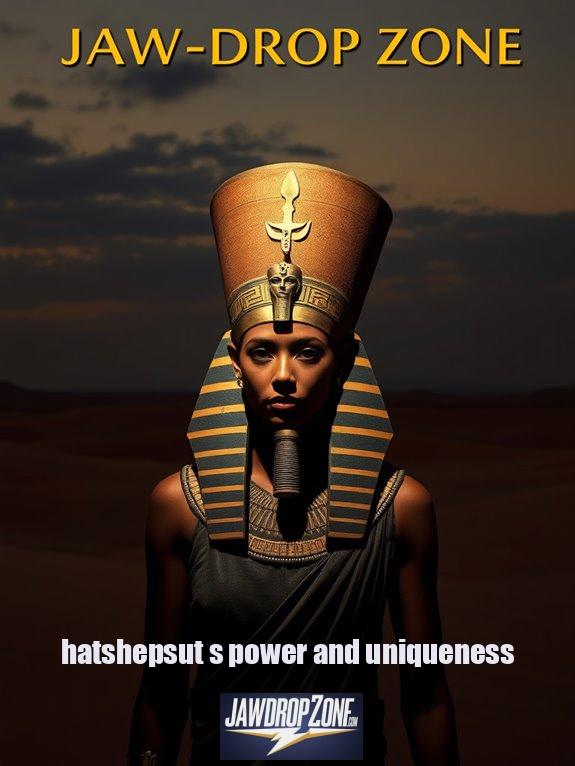
    hatshepsut s power and uniqueness

    Hatshepsut’s ascent to power is nothing short of a riveting tale—especially when you consider she did it smack in the middle of a patriarchal society that just wasn’t ready for a female pharaoh.

    Imagine stepping into your half-brother’s shoes as regent after your husband’s death. That’s exactly what I did, overseeing Thutmose III’s reign while skillfully managing state affairs.

    But why just stall in regency when you can don the male regalia and declare yourself a pharaoh? I leveraged divine backing, claiming I was the daughter of Amun—talk about pulling the ultimate power move! Female mystics, like those throughout history, have also used their perceived divine connections to influence political landscapes.

    Every clever decision I made—from building alliances with priests to flaunting royal titles—served to break those age-old gender norms. My significant contributions to trade networks also played a crucial role in strengthening my position and asserting my authority.

    Doesn’t it astonish you how I navigated this labyrinth of power? If there’s a lesson here, it’s this: control isn’t just a privilege; it’s an art, one that I mastered beautifully.

    Welcome to Jaw Drop Zone, where stories like mine will leave you breathless!

    Political Strategies and Legacy of Hatshepsut

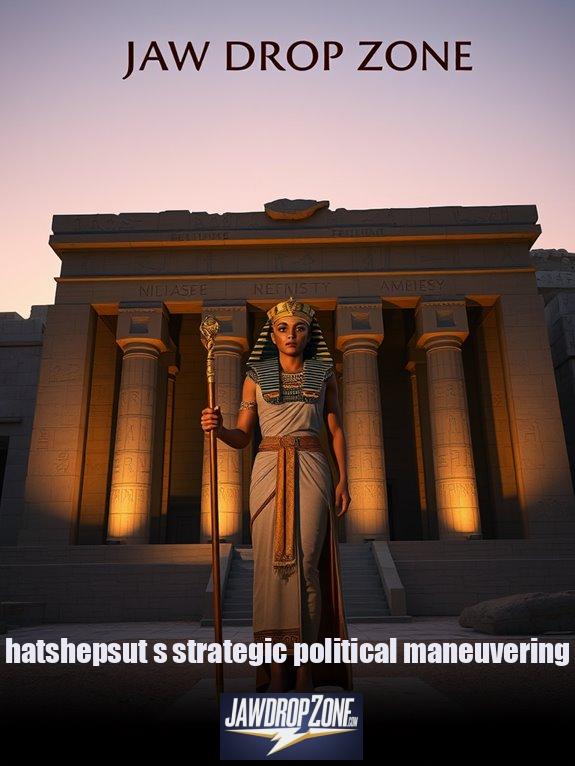
    hatshepsut s strategic political maneuvering

    Steering through the treacherous waters of ancient Egyptian politics, I painted a bold picture of power that turned heads and raised eyebrows across the domain.

    Can you envision solidifying my rule by etching divine stories on temple walls? I did just that, linking my legitimacy to Amen himself!

    Solidifying my reign through divine narratives carved in stone, I forged an unbreakable bond with Amen!

    Replacing skeptical officials, I filled key positions with loyal supporters, effectively curbing opposition.

    And while women’s status was higher in Egypt than elsewhere, my reign? Controversial and revolutionary.

    Remember the remarkable Punt expedition? My diplomatic trade routes didn’t just usher in ivory and incense; they revitalized Egypt’s coffers and influence!

    Architectural marvels like my mortuary temple at Deir el-Bahri? They screamed my dominance!

    But let’s be real—my legacy faced an erasure attempt worth a plot twist, thanks to Thutmose III.

    Yet here I stand, a beacon of female power through time—my journey showcased on Jaw Drop Zone, where history reveals truths often buried!

    Interestingly, my maneuvering mirrors the calculated strategies of other powerful women, such as when Elizabeth’s bloodless coup secured her throne in Russia without shedding blood.

    Hatshepsut’s Bold Male Disguise

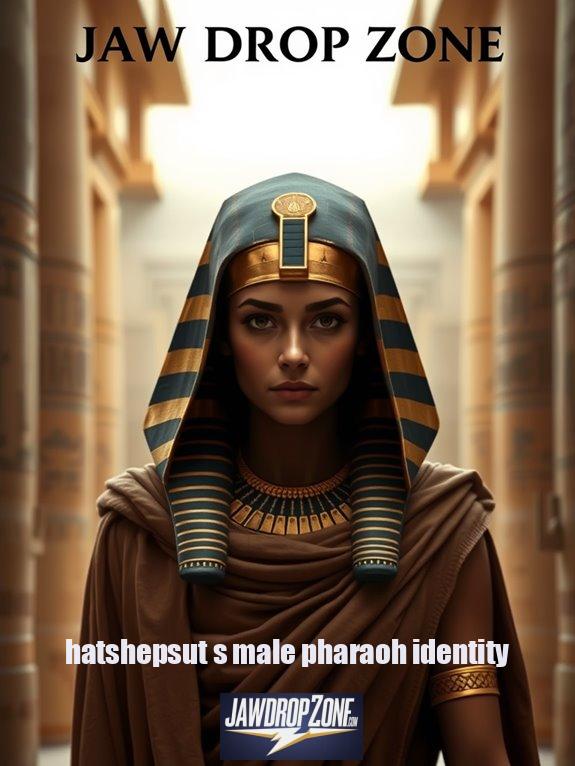
    hatshepsut s male pharaoh identity

    In a world where wearing a dress could mean losing a kingdom, I’d to think outside the box—or in my case, the wardrobe!

    To command respect and authority, I embraced a striking male disguise that altered perceptions of power.

    Here’s how I redefined what it meant to be a ruler:

    • Legitimacy Matters: My male form helped gain acceptance from courtiers, where masculinity equated to power.
    • Visual Transformation: I traded in flowing gowns for male kilts, ensuring colorful depictions exuded authority.
    • Artistic Conformance: I conformed to established art standards, showcasing strength as a pharaoh.
    • Divine Connection: I wore the nemes headdress, a bold statement of my divine authority.
    • Symbolic Emphasis: My choice to wear a false beard was deeply rooted in Egyptian tradition, emphasizing the connection to male pharaohs and legitimacy.

    References

  • 7 Best Ways Nefertiti Transformed Ancient Egyptian Religion

    7 Best Ways Nefertiti Transformed Ancient Egyptian Religion

    Nefertiti’s revolution in ancient Egyptian religion was nothing short of jaw-dropping! She dared to shift from polytheism to monotheism, elevating Aten as the one true god. Fascinating, right? Picture open-air temples where worship thrived, all while she redefined fertility ideals, showcasing her divine connection. Her stunning iconography turned heads, and her political influence reshaped societal power dynamics. Curious about how this intriguing queen managed it all? Stick around—the story just gets better!

    Quick Takeaways

    • Nefertiti elevated the Aten as the singular god, shifting worship from the traditional pantheon to a focus on the sun god alone.
    • She served as high priestess, centralizing religious authority and diminishing the power of established priests.
    • Nefertiti influenced political reforms that interwove governance with religious practices, solidifying royal control over spiritual life.
    • Iconography depicting Nefertiti emphasized her divine role and connection to fertility, enhancing perceptions of female divinity.
    • The establishment of Akhetaten facilitated community engagement in worship, transforming social structures and loyalties around the Aten.

    Shift From Polytheism to Monotheism

    transition to singular deity

    The rise of monotheism in ancient Egypt was like a dramatic plot twist in a gripping novel—one that many never saw coming, yet it reshaped an entire civilization.

    Envision a world where the traditional pantheon of gods was abruptly replaced; that’s what the Amarna Period delivered. Temples dedicated to old deities crumbled, red ink splattering over centuries of tradition.

    Why? Because the pharaoh and queen seized religious authority, shifting power from priests to their royal palms.

    Even Nefertiti, crowned as a high priestess, radiated influence like a golden sun! With her by Akhenaten’s side, they centralized faith in Aten—an audacious leap that left the elite fuming and the masses confused.

    How does one woman, in such a tumultuous time, wield that kind of transformational power? That’s what sparked my journey on Jaw Drop Zone—to reveal history’s shocking twists that deserve the spotlight!

    Can you feel the gravity of her legacy?

    Elevation of the Aten as the Singular God

    aten as sole deity

    While Akhenaten dazzled the ancient world by declaring Aten the singular god, turning celestial belief on its head, I can’t help but marvel at the sheer audacity of it all.

    Imagine, a sun disc, not human, ruling supreme—Aten’s rays epitomized a drastic shift. Traditional temples? Closed. What a bold move! Worship happened under the blazing sun, free from priests’ control.

    Aten’s rays marked a daring shift, closing traditional temples and liberating worship from priestly grasp under the open sun.

    But hold on, where’s the fun in monotheism without a queen? Nefertiti stood by her husband, championing this radical belief. Did she know she’d shape a new era?

    It’s astonishing how one couple pushed for such monumental change, overthrowing centuries of polytheistic comfort. So, was this a true elevation or a temporary fad? Sadly, after Akhenaten’s reign, the Aten flickered out!

    I started Jaw Drop Zone to share such enthralling stories about history—didn’t expect ancient drama to be this juicy, did you?

    Promotion of Fertility Ideals in Religious Practices

    fertility beliefs in religion

    With Akhenaten’s bold proclamation of Aten as the singular god, you might think that was the end of the story for ancient Egyptian beliefs. But hold on—Nefertiti didn’t just stand by; she took fertility ideals to a whole new level.

    • Nefertiti often appeared surrounded by symbols of fertility, like children and life.
    • She’s closely tied to goddesses such as Hathor, reinforced as a divine fertility icon.
    • Artistic depictions exaggerated her feminine features, making her beauty a beacon for fertility.

    Could her influence actually shape societal norms? Absolutely. By actively participating in rituals, she highlighted fertility’s critical role in Egyptian culture.

    This elevated her to divine kinship and made her the embodiment of reproductive power.

    You see, understanding Nefertiti’s legacy isn’t just about ancient history; it’s about recognizing the alluring pull of feminine strength. Wouldn’t you want to unravel such enchanting narratives?

    Iconography Reinforcing Nefertiti’s Divine Role

    nefertiti s divine symbolism explained

    Iconography surrounding Nefertiti isn’t just about pretty pictures—it’s a vibrant symbol of her divine role in ancient Egyptian religion. Have you ever wondered how a simple crown could alter the course of a society? Nefertiti’s tall, blue crown did just that, marking her as not just a queen but a potent spiritual leader.

    In Theban tombs, we see her alongside Akhenaten in rituals that seamlessly blend earthly and celestial responsibilities, challenging the norms of her era.

    These images of her, participating in the worship of the sun god Aten, didn’t merely highlight her beauty; they reinforced her divine power.

    It’s fascinating, right? We’ve got to give Nefertiti credit for being way ahead of her time, turning her image into a dynamic force within ancient Egyptian religion.

    Isn’t it thrilling to think about how this lifestyle echoes into the present? Join me in exploring more at Jaw Drop Zone!

    Implementation of New Religious Texts

    Nefertiti didn’t just wear an impressive crown; she also helped to orchestrate a monumental shift in religious thought through the implementation of new sacred texts.

    Can you envisage the impact of those texts? It wasn’t just about pretty words; it was a revolution!

    Here are some mind-bending features of this game-changing doctrine:

    • The Great Hymn to the Aten—a stunning declaration of Aten’s supremacy that eclipsed traditional gods.
    • Nefertiti, often depicted independently, reshaped her role, offering to Aten as if she were a king.
    • The widespread dissemination and accessibility of these texts honored a monotheistic approach, sidelining centuries-old traditions.

    This wasn’t mere fluff; it was a daring power play!

    If this historical twist intrigues you, stick around as I unravel more about this incredible woman and her legacy on my site, Jaw Drop Zone. You’ll want to share these revelations!

    Influence on Artistic Representations of Deity

    divine portrayals in art

    In an era when pharaohs usually held the spotlight, it’s astounding how a queen caught everyone’s eye by reimagining divine artistry in ancient Egypt. Nefertiti didn’t just settle for ceremonial participation; she embodied divine power.

    Picture her, in images typically reserved for pharaohs, wearing that striking crown usually saved for goddesses. How’s that for breaking norms?

    Her artistic representations, often with her six daughters, highlighted her as a fertility goddess, embracing life and rebirth.

    Nefertiti’s portrayals with her daughters celebrated her as a fertility goddess, symbolizing life, love, and renewal.

    Isn’t it wild that the culture for ages emphasized male rulers, yet here’s Nefertiti, depicted as a warrior defeating enemies? I mean, who knew art could flip gender stereotypes on their head?

    Her legacy? Her iconic bust remains a symbol of ancient Egyptian culture, shaping not just history but also ideas about female divinity. Notably, Nefertiti’s reign marked a significant transition toward monotheism that influenced future generations.

    Isn’t it time we explore the fascinating depths of her influence?

    Political Involvement in Religious Reforms

    religious reforms influenced politics

    While many might think that ancient Egypt revolved solely around pharaohs and their grand temples, the truth is far more riveting—one queen flipped the script on their entire religious terrain!

    Nefertiti and Akhenaten shattered the status quo, weaving politics tightly into their religious reforms. Envision the audacity of closing traditional temples to elevate Aten as the supreme deity!

    Here’s how she did it:

    • Introduced Monotheism: By promoting Aten as the only god, Nefertiti set the stage for a revolutionary religious order.
    • Dismantled the Old Guard: They worked to minimize the power of established priests, reshaping authority in ancient Egypt.
    • Founded Akhetaten: Their creation of a city just for Aten worship showed the power they wielded.

    Can you believe Nefertiti wasn’t just a queen, but a political powerhouse?

    That’s why I launched this site, Jaw Drop Zone—to uncover such compelling twists in history.

    Nefertiti’s Revolutionary Monotheistic Beliefs

    nefertiti s monotheistic faith

    Long before the concept of modern monotheism graced our world, two ancient figures dared to shatter the long-standing conventions of spirituality—talk about bold moves! Nefertiti and Akhenaten flipped the script on Egypt’s polytheistic norms, introducing the sun god Aten as the sole deity. Visualize the audacity!

    Picture this: vibrant depictions of Nefertiti and Akhenaten, not just royalty, but as divine intermediaries directly connected to Aten.

    Vibrant depictions showcased Nefertiti and Akhenaten as divine intermediaries, boldly redefining royalty’s connection to Aten.

    In their newly built city of Akhetaton, worshiping Aten took on an artistic flair, with open-air temples radiating life and fertility.

    You might wonder, how did this reshape power dynamics?

    References

  • 3 Divine Queens Who Dominated Ancient Egypt

    3 Divine Queens Who Dominated Ancient Egypt

    When you think of ancient Egypt, do you picture just pharaohs? Think again! Hatshepsut seized the throne, ruling as a full-fledged pharaoh, while Tiy, a commoner turned queen, transformed diplomatic relations. Ahhotep warrior-queen fought fiercely to protect her lineage. These divine women not only rocked the royal robes, but they also wielded real power, reshaping the empire. Curious about how these queens changed the game? Stick around—there’s so much more to uncover!

    Quick Takeaways

    • Neithhotep is recognized as possibly the first queen of Egypt, setting a precedent for female authority in a unified nation.
    • Hatshepsut declared herself pharaoh, ruling for 21 years and initiating major trade route expansions and architectural projects.
    • Tiy transitioned from commoner to a powerful queen, significantly influencing diplomacy and governance in the reign of Amenhotep III.
    • Ahhotep demonstrated military prowess and strength, protecting her lineage and showing that queens could be formidable leaders in war.
    • These queens leveraged divine legitimacy and adopted masculine symbols to assert authority in a predominantly male-centric society.

    Powerful Queens of Ancient Egypt

    ancient egypt s influential queens

    When we think of ancient Egypt, it’s easy to envision grand pyramids and mighty pharaohs, but what about the queens who wielded significant power behind the scenes? They weren’t just decorative figures draped in linen; they were architects of political strategy and cultural legacy.

    Take Neithhotep, for example. She was likely the first queen to emerge in an era when power dynamics were still being figured out. As the wife of Narmer, the unifier of Egypt, Neithhotep wasn’t just a royal consort—she might’ve held real regnal power, embodying the very essence of authority at a time when most women didn’t dare to dream of it. Her contributions were crucial for laying the foundation of a united Egypt. She set a precedent for royal women to occupy positions of power previously reserved for men.

    Envision a woman with the power to shape a nation right from the very beginning!

    Then there’s Hatshepsut, who took audacity to a whole new level by declaring herself pharaoh. For 21 years, she ruled, redirecting trade routes and commissioning epic monuments while rocking that killer headpiece.

    Who wouldn’t want a queen who didn’t just stand beside a king but actually took the reins, calling the shots and getting things done? Her story is a reminder that sometimes you need to step into the spotlight and claim your power!

    And we can’t forget about Tiy, a queen who went from commoner to royal powerhouse, juggling her husband’s diplomatic affairs. She wasn’t just a figurehead, making herself indispensable to Amenhotep III.

    Talk about relationship goals! When a queen can wield that kind of influence, you realize that royal life is so much more than extravagant banquets and flowing gowns.

    Now, let’s chat about Ahhotep. Honored for her military valor, she earned her stripes on the battlefield. A mother protecting her children’s future?

    That’s the kind of fierce we love! Her role speaks to the strength and authority embodied by the queens of Egypt, proving they were more than just pretty faces—they were forces to be reckoned with.

    These queens crafted a legacy that’s a reflection of the balance of power. They wielded titles like “King’s Mother” with pride, ensuring their sons’ legitimacy, while also owning property and engaging in economic activities.

    It’s fascinating to see how these women navigated a world dominated by men, right? They didn’t just fit into their roles—they shaped them.

    Curious about more jaw-dropping tales from history? That’s exactly why I created Jaw Drop Zone, to unravel the hidden stories.

    But for now, let’s toast to these magnificent women who ruled ancient Egypt with strength and grace, proving once and for all that queens can absolutely reign supreme!

    Divine Female Pharaohs’ Authority

    powerful female pharaohs rule

    While most histories highlight male rulers, it’ll absolutely surprise you to learn just how powerful female pharaohs truly were in ancient Egypt.

    These remarkable women didn’t just sit pretty on thrones—they seized authority and shattered norms.

    • They donned masculine attire, wielding symbols like false beards to command respect.
    • Their divine connections fostered legitimacy, with Hatshepsut declaring herself the daughter of Amun.
    • Even in a patriarchal society, they reigned, driving significant political and cultural reforms.

    Doesn’t that blow your mind? I mean, isn’t it nuts how these queens carved their names boldly into history?

    I created Jaw Drop Zone to share these fascinating stories, and trust me, you’ll want to dive deeper into their extraordinary legacies.

    References

  • Merit-Ptah: Ancient Egypts Pioneering Woman Physician Leader

    Merit-Ptah: Ancient Egypts Pioneering Woman Physician Leader

    Did you know Merit-Ptah might actually be a legendary figment rather than Egypt's first female doctor? Yup! This so-called pioneer, often touted in history books, could be a classic case of mistaken identity with Peseshet, a real medical whiz! Isn't it wild how we romanticize myths? Women like Peseshet truly shaped medicine in ancient Egypt, proving that ladies were as impactful back then as we are now. Curious about more incredible female healers from history? Stay tuned!

    Quick Takeaways

    • Merit-Ptah is often credited as the first female doctor in ancient Egypt, symbolizing women's vital contributions to medicine.
    • Recent research suggests that Merit-Ptah may be a confusion with Peseshet, an actual historical figure overseeing female healers.
    • Her narrative reflects the significant presence and influence of women in various professions, especially in healthcare, in ancient Egyptian society.
    • Female physicians in the pharaoh's court played crucial roles in influencing royal health policies and advancing medical practices.
    • The stories of women like Merit-Ptah inspire discussions on female representation in science, emphasizing the need to recognize historical contributions.

    The Myth and Reality of Merit-Ptah

    merit ptah ancient medical pioneer

    Envision wandering through the sun-drenched sands of ancient Egypt, where the pyramids tower against a brilliant blue sky and history whispers the tales of remarkable figures. Picture stumbling upon a name that's sparked fiery debates among historians: Merit-Ptah, who's often dubbed as the first female doctor. Sounds fascinating, right?

    But here's the kicker—recent research suggests she might never have existed!

    The allure of Merit-Ptah captured minds, especially when Kate Campbell Hurd-Mead popularized her story in the 1930s, sketching her as a chief physician in the pharaoh's court. You'd think she'd be a rock star of ancient medicine. However, historical accuracy comes into play, as scholars like Jakub Kwiecinski uncovered that her name likely got tangled up with Peseshet, another esteemed female healer.

    Can you believe it? One confusing name leading to a cascade of misconceptions.

    One name can unravel a tapestry of historical truths, sparking endless debates and intrigue.

    Yet, this story transcends the mere existence or nonexistence of an individual. It highlights the genuine contributions of female healers in ancient Egypt, where women weren't just window dressing; they served in various professions, including medicine! This includes the verified accomplishments of Peseshet, the overseer of healer women, who serves as an important reminder of women's roles in health care during that era. During their time, women like Peseshet were influential figures in ancient Egyptian medicine, showcasing that female contributions were significant.

    So, while Merit-Ptah may be a fictional heroine, her legacy reflects the women who truly shaped science and healing.

    Isn't it wild to think how the myths we create influence our world today? I created this website, Jaw Drop Zone, because I wanted to explore such intricacies, showcasing the power of stories—real or exaggerated.

    Whether through Merit-Ptah's fictional narrative or Peseshet's verified accomplishments, it's a sign of women's indelible mark on history.

    What's your take—do we need more of these stories to inspire the new generation of female experts?

    Pharaoh's Royal Medical Advisor

    ancient egyptian health expert

    When you consider the importance of health in ancient Egypt, it's hard not to be amazed by the role of the Pharaoh's royal medical advisor—an individual who wielded considerable influence in the shadows of the throne.

    With their wisdom in medical practices and royal influence, these advisors shaped health policies, ensuring the pharaoh's wellness while quietly transforming society's views on medicine. This role was exemplified by ancient Egypt's first female physician, who paved the way for future generations of women in medicine.

    Isn't that fascinating?

    References

  • Hidden Queens: Egypts Erased Female Pharaohs Revealed

    Hidden Queens: Egypts Erased Female Pharaohs Revealed

    Did you know ancient Egypt had some fierce female pharaohs whose legacies were mostly hidden? It's shocking, but queens like Hatshepsut revitalized trade and built magnificent temples, yet their stories were nearly erased! Envision steering through a male-dominated world while sporting royal regalia—talk about a power move! These queens deserve a spotlight, don't you think? As I created this site, Jaw Drop Zone, to uncover such hidden gems, let's uncover more astonishing tales together!

    Quick Takeaways

    • Female pharaohs like Merneith and Sobekneferu played crucial roles but are often overlooked in historical narratives.
    • Many powerful women rulers faced erasure due to societal biases that favored male leadership.
    • Hatshepsut's successful reign exemplifies women's capabilities in governance and economic revitalization in ancient Egypt.
    • Rituals and symbols were used by female pharaohs to assert their legitimacy in a patriarchal society.
    • Recognizing the contributions of these female rulers enriches our understanding of Egypt's diverse historical landscape.

    Female Pharaohs: Unveiling Their Hidden Legacy

    female rulers of egypt

    Hidden away in the sands of time, Egypt's female pharaohs often get overshadowed by their male counterparts, but their stories are nothing short of extraordinary. Can you envision a time when women wielded power as pharaohs, shaping the course of history?

    Take Merneith, for instance, believed to be the first female ruler of Egypt. She's a prime example of how female rulers navigated the complex power dynamics of a male-dominated society. Rituals of legitimacy were often employed to bolster their positions and assert their authority.

    Then there's Sobekneferu, the first confirmed female pharaoh, who ruled during the Twelfth Dynasty. She didn't just sit on a throne; she completed her father's pyramid complex—her father's pyramid complex—talk about legacy!

    And let's not overlook Nefertiti, whose influence alongside Akhenaten changed religious practices. She wielded her power like a master tactician, all while challenging the status quo.

    Women often found themselves in leadership roles when male heirs were absent or during times of crisis. Picture it: a society in turmoil, and a woman steps up, adopting male regalia to assert her legitimacy.

    These queens knew how to play the game, using symbols of power to carve their place in history.

    But here's the kicker: despite their achievements, many of these powerful women are often erased from the narrative. Why is that? Maybe it's because their stories disrupt the traditional tales we've all been told.

    Neglected Legacy of Hatshepsut

    hatshepsut s overlooked historical significance

    While it's easy to overlook the contributions of female rulers in ancient history, Hatshepsut's reign as Pharaoh of Egypt is a startling reminder of what women can accomplish when given the chance.

    Her achievements, from the Djeser-Djeseru Temple to revitalizing trade routes, shine bright against historical misrepresentation. Hatshepsut was not only a skilled diplomat but also a master of ancient trade networks, which allowed her to strengthen Egypt's economy and influence.

    Isn't it time we celebrated this remarkable woman and reclaimed her rightful place in history?

    References

  • 10 Best Secrets Behind Queen Hatshepsuts Sacred Beard

    10 Best Secrets Behind Queen Hatshepsuts Sacred Beard

    Hatshepsut's sacred beard was her secret weapon against the norms of ancient Egypt. Envision a queen, boldly asserting her authority with a faux symbol of masculinity! It wasn't just a fancy accessory—it signified wisdom and strength. This audacious choice helped her claim the throne, challenging societal expectations head-on. Who knew a beard could pack such power? It's a jaw-dropping twist in history, don't you think? Stick around to uncover more surprises about this iconic pharaoh!

    Quick Takeaways

    • Hatshepsut's false beard symbolized her authority and wisdom, blending traditional masculinity with femininity in a male-dominated society.
    • The beard served to legitimize her claim to the throne, reinforcing her divine right as a female pharaoh.
    • It highlighted her strength and capability as a ruler, countering societal expectations of women in leadership.
    • The false beard became a powerful emblem of royal power, connecting her to the divine lineage of pharaohs.
    • Archaeological discoveries have revived interest in Hatshepsut's story, emphasizing her unique approach to femininity and leadership in ancient Egypt.

    Hatshepsut: The Pharaoh Who Redefined Power

    female pharaoh redefines leadership

    Have you ever wondered how a woman managed to break the glass ceiling of ancient Egypt? Enter Hatshepsut, the Pharaoh who donned a false beard and claimed her divine right to rule. Imagine this: it's 1479 B.C., and a woman stands tall, declaring herself the rightful ruler after the death of Pharaoh Thutmose II. Talk about bold!

    Hatshepsut didn't just wear any ordinary crown; she adopted the full regalia, including a ceremonial false beard, a powerful symbol of wisdom and authority. That's right, she rocked a beard to assert her legitimacy in a world dominated by men. Who says a woman can't have a little facial hair?

    Hatshepsut boldly donned a ceremonial false beard, flipping the script on gender roles in ancient Egypt!

    Her architectural achievements were jaw-dropping too! Just look at her magnificent temple at Deir el-Bahri, blending seamlessly with the Theban scenery. It wasn't just a pretty building; it was a statement. Inside, reliefs depicted her military triumphs, showcasing her strength and skill. She wasn't just a ruler; she was a force to be reckoned with. Her reign was perceived as prosperous due to her ability to maintain peace and competence.

    Yet, after her reign, Thutmose III tried to erase her legacy. Can you believe it? Statues defaced, names chiseled away. But the truth has a way of surfacing, doesn't it?

    Thanks to archaeology, Hatshepsut's story is being rediscovered and celebrated today.

    Symbol of Royal Authority

    emblem of sovereign power

    In the grand tapestry of ancient Egypt, few symbols shout "royal authority" quite like a pharaoh's false beard.

    Worn by Hatshepsut, it wasn't just a fashion statement; it screamed divine connection! Envision a clean-shaven world where this metallic marvel set her apart, blending femininity with masculinity. Hatshepsut claimed royal lineage as the daughter of Thutmose I, further solidifying her status. Isn't it fascinating how a simple beard could legitimize power and challenge norms? Who knew history had such stylish secrets?

    References