When exploring Sagrada Familia, you’re stepping into a world where every stone tells a story. Did you know its 18 towers symbolize the apostles and Evangelists? Or that twisted columns mimic palm trees, representing divine touch? The stained glass doesn’t just dazzle; it transforms light into emotional epiphanies! Visualize unearthing hidden messages nestled in the architecture. Isn’t it fascinating how faith, nature, and artistry intertwine? I created Jaw Drop Zone to ignite that spark of discovery. And there’s so much more to uncover!
Quick Takeaways
- Sagrada Familia is adorned with crosses and patron saints, integrating religious iconography throughout its architectural design.
- Hidden messages within the structure invite exploration, revealing deeper spiritual insights and connections to faith.
- Each façade narrates a distinct chapter of Jesus’ life, emphasizing the significance of religious storytelling through architecture.
- The intertwining of nature and faith is evident in the design, with columns resembling palm trees symbolizing divine interaction.
- Stained glass windows are crafted with intentional hues, enhancing emotional responses and reflecting themes of birth, passion, and resurrection.
Exploring the Symbolism of Sagrada Familia

As I wandered through the elaborate corridors of the Sagrada Familia, I couldn’t help but marvel at the secrets hidden within its stone embrace. The facades alone are epic tales carved into solid form, each representing distinct chapters in Jesus’ life. Ever heard of storytelling through imagery? Well, Gaudí certainly did. In a time when literacy was scarce, he cleverly turned this basilica into a colossal visual lesson.
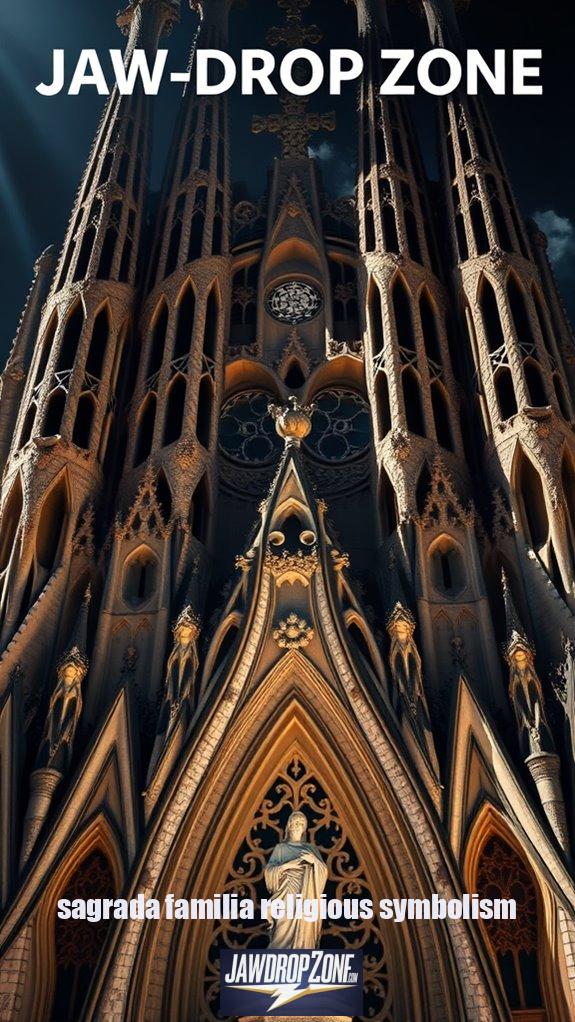
Let’s talk about the iconic towers that pierce the sky. There are 18 in total—12 dedicated to the apostles and 4 to the Evangelists. Isn’t that just stunning? The tallest one, honoring Jesus Christ himself, is designed to reach a height of 172.5 meters. But here’s the catch—it’s intentionally crafted to stay beneath the majestic Montjuïc, a nod to nature’s supremacy. Talk about architecture with a conscience!
The Sagrada Familia’s 18 towers honor divine figures, with the tallest humbly bowing to nature’s majesty.
Now, if you think beauty comes without symbolism, think again. Each column twists and turns like palm trees, creating a naturalistic focus that symbolizes divine interaction. Isn’t it fascinating how Gaudí salvaged real-life inspiration from the world around him? Moulds taken from actual animals infuse vitality into sculptures that are as much about faith as they’re about nature.
What could be more mesmerizing than stained glass windows shining with vibrant hues, conveying themes like birth, passion, and resurrection? Each ray of light symbolizes something deeply spiritual, evoking emotional responses you just can’t ignore. Have you ever pondered how a mere structure can be a reflection of the divine?
The façades, oh, the façades! Take the Nativity Façade, for example. It features a cypress tree symbolizing life itself. It’s like a new revitalizing breeze, reminding us that life is intertwined with faith. Also, let’s not forget that the three main facades collectively tell the overall narrative of Jesus’ life.
And the Passion Façade? It hosts excerpts from Jesus’ Passion in an array of languages—talk about inclusivity!
Now, while I’ve created this little nook of mine—Jaw Drop Zone—to uncover such gems, the Sagrada Familia is an awe-inspiring repository of knowledge. From crosses to patron saints adorning every nook and cranny, this basilica is a treasure chest of religious iconography.
As I conclude my exploration, I can’t help but feel empowered. The Sagrada Familia doesn’t just tell a story; it weaves narratives of faith, nature, and artistry—brilliantly united. What revelations have you’d in your own journey of exploration?
Hidden Messages in Architecture

Hidden within the walls of the Sagrada Familia are whispers of deeper meanings, waiting to be uncovered.
Imagine stepping into a sacred space where nature and faith intertwine, each element meticulously crafted to tell a story.
Here are some secrets you mightn’t know:
- Divine Influences: The elaborate designs echo natural forms, resembling tree trunks and spiraling staircases.
- Symbolic Towers: Each of the 18 towers embodies a significant figure in Christianity, a veritable hierarchy of faith.
- Color as Emotion: Stained glass windows don’t just dazzle; they steal your breath away, evoking deep emotions and spiritual reflection.
Isn’t it time you discovered these hidden messages?
Immerse yourself in the beauty of Sagrada Familia with me—your journey into architectural mastery starts here, at Jaw Drop Zone!
References
- https://www.catalannews.com/life-style/item/symbolism-and-hidden-meanings-behind-the-sagrada-familia
- https://ramblingrussells.com/sagrada-familia/
- https://www.contexttravel.com/blog/articles/sagrada-familia-interior
- https://en.wikipedia.org/wiki/Sagrada_Família
- https://www.casabatllo.es/en/news/symbology-religion-gaudi-work/
- https://www.contexttravel.com/stories/articles/sagrada-familia-interior
- https://sacyr.com/en/-/los-secretos-de-la-sagrada-familia/blog