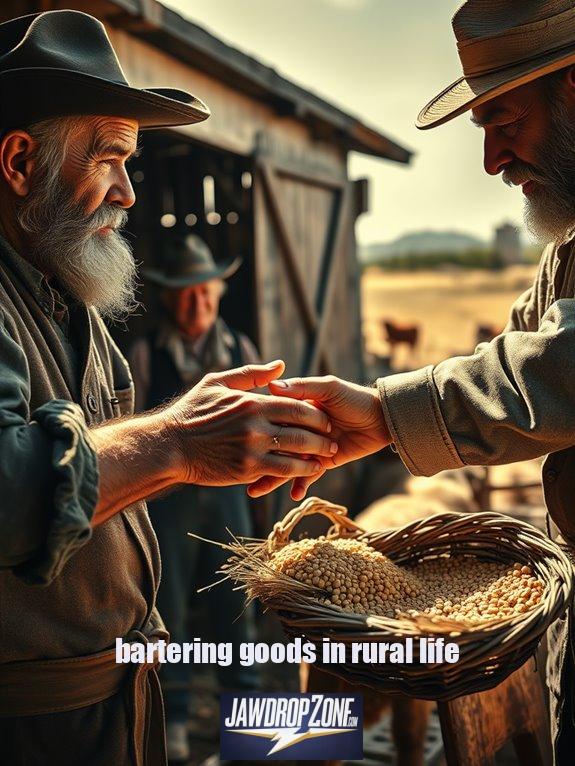
Back in the day, I'm talking ancient times, people bartered for medical supplies like their lives depended on it—because sometimes, they did! Envision doctors exchanging life-saving treatments for a flock of sheep or some bushels of grain. Rather surprising, right? This ain't just some quirky history; it's a proof of how need and resourcefulness shaped our survival. Curious about how these practices laid the groundwork for modern healthcare? Stick around and let's uncover more fascinating details together!
Quick Takeaways
- Medical services, such as consultations, were commonly exchanged for medical supplies during economic hardships.
- Stethoscopes and other tools were valuable assets in trade for necessary medical resources.
- Bartering provided a means to access healthcare when cash was scarce, especially during crises like the Great Depression.
- Trust and negotiation played crucial roles in determining the value of exchanged medical supplies.
- Historical grain exchanges illustrate how bartering shaped economies and community health, influencing medical supply transactions.
Bartering: A Historical Perspective on Medical Supplies
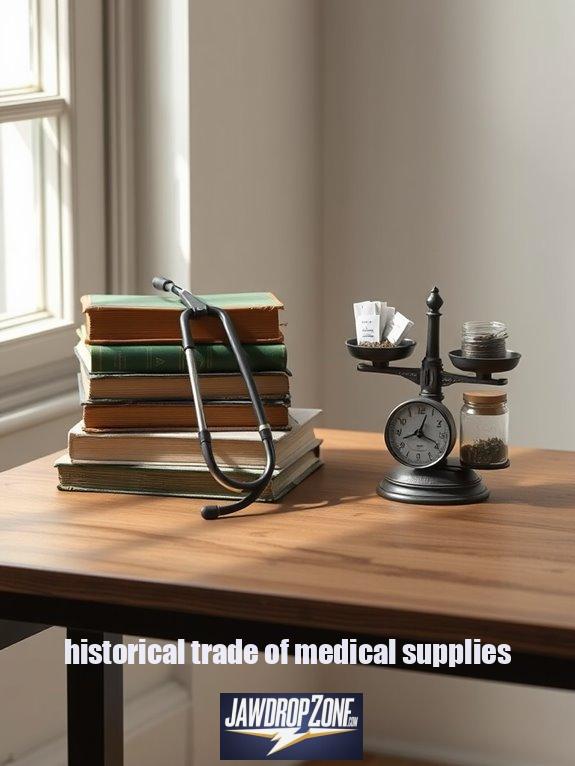
Envision a world where the stethoscope in your hand isn't just a tool, but a ticket to a treasure trove of medical supplies. Conceive bartering your expertise for essential items—sounds like a dream, right? Yet, this was once a vibrant reality, steeped in historical practices that made healthcare more accessible during tough times.
Back in the day, when cash was scarce, folks traded everything from furs to spices, and yes, medical supplies were part of the mix. Can you picture a doctor swapping a consultation for a box of bandages? Those bartering benefits weren't just practical; they were lifelines! During economic crises like the Great Depression, bartering surged, revealing how resourceful humanity can be when the chips are down. This practice often included the exchange of medical supplies as they became vital when care was unavailable.
What's truly fascinating is how modern healthcare is reviving this age-old practice. Today, trade exchanges facilitate transactions using virtual currencies, like "trade dollars." It's like a secret club where medical professionals can trade services instead of cash. This not only slashes operational costs but also expands networks and patient referrals. Who wouldn't want to save money while enhancing their practice?
But let's get real—bartering isn't all rainbows and sunshine. Trust is key, and if you misrepresent what you're trading, you could find yourself in a sticky situation.
Plus, agreeing on the value of goods can feel like trying to negotiate with a toddler over candy.
Ancient Farmers Exchanged Grain

What Bartered For Medical Supplies Back Then?
Ancient Farmers Exchanged Grain
Envision a time when trading a handful of grain could change the fate of an entire community.
Ancient farmers, through grain cultivation, shaped economies and fostered connections.
Visualize the thrill of bartering precious grain, a currency of survival!
Imagine the excitement of trading vital grain, the lifeblood of communities and the key to prosperity!
Without it, entire civilizations faced famine.
Isn't it wild how these exchanges laid the groundwork for the vibrant societies we now cherish? In those times, the absence of modern sanitation systems often led to waterborne disease outbreaks, significantly impacting public health and agricultural productivity.
References
- https://www.outdoorlife.com/blogs/survivalist/survival-skills-10-great-bartering-items-and-3-you-might-not-expect/
- https://tradebank.com/fool-proof-guide-to-bartering-in-the-medical-industry/
- https://squareup.com/us/en/the-bottom-line/managing-your-finances/a-history-of-the-trade-and-barter-system
- https://www.tandfonline.com/doi/full/10.1080/20780389.2019.1694408
- https://noblegoldinvestments.com/bartering-during-an-economic-collapse/
- https://www.britannica.com/event/Columbian-exchange
- https://en.wikipedia.org/wiki/History_of_agriculture
- https://source.washu.edu/2019/02/prehistoric-food-globalization-spanned-three-millennia/
- https://www.ncpedia.org/anchor/columbian-exchange
- https://foodinstitute.com/focus/whats-old-is-new-again-harvesting-ancient-grains-in-fb/