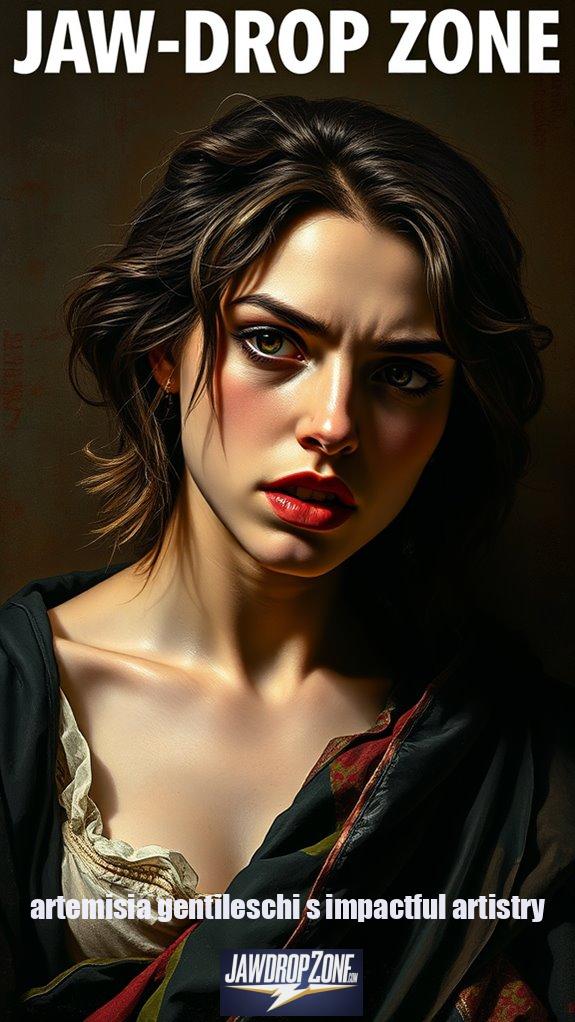
Tag: female artists

  • 5 Bold Brushstrokes That Made Artemisia Gentileschi Famous

    5 Bold Brushstrokes That Made Artemisia Gentileschi Famous

    Artemisia Gentileschi didn't just paint; she wielded her brush like a sword! Her fearless representation of female strength, particularly in *Judith Slaying Holofernes*, was revolutionary. Can you believe she shattered the mold in a male-dominated world? Her masterful use of chiaroscuro turned ordinary scenes into breathtaking emotional tales. Each stroke screamed empowerment, defying societal expectations. Talk about a legacy! If you're curious about how she inspired generations, stick around to discover more fascinating layers of her brilliance.

    Quick Takeaways

    • Gentileschi's *Judith Slaying Holofernes* showcases female empowerment, transforming women's roles from passive to powerful in art.
    • Her innovative compositions feature dynamic angles and engaging subjects that draw viewers into the narrative.
    • Mastery of chiaroscuro effects in her work creates deep emotional intensity and highlights the characters' inner conflicts.
    • Navigating a male-dominated art world, Gentileschi challenged societal constraints on women artists, paving the way for future generations.
    • Her lasting influence continues to inspire contemporary discussions around feminism and female representation in the arts.

    Artemisia Gentileschi: A Pioneer of Empowerment

    empowering female artistic expression

    As I explore the vibrant world of Artemisia Gentileschi, I can't help but feel a surge of excitement, knowing I'm about to reveal the bold brushstrokes of a woman who defied convention. Gentileschi was a master at merging Caravaggio's dark realism with her fierce vision as a woman artist. Can you envision the shockwaves rippling through her contemporaries as she wielded her brush like a sword?

    Her paintings are filled with expressive figures that burst with raw emotion. Take *Judith Slaying Holofernes*, for instance. It's not just a historical scene; it's an intensely personal narrative of empowerment and resilience. How often do we see women depicted in such transformative power instead of as passive onlookers? This was Gentileschi's distinctive stamp on a male-dominated narrative—a bold statement that still resonates today. Her art not only challenged expectations but also laid the groundwork for women's representation in the arts.

    And let's talk about her innovative compositions. They're anything but dull. She infused energy and life into her scenes, often placing her subjects at dynamic angles that draw the viewer in. The intensity is palpable; you almost find yourself rooting for Judith as her blade catches the light just right!

    Just consider what it was like for Gentileschi, maneuvering a world hostile toward women expressing their agency. Despite societal constraints, it's no wonder I created Jaw Drop Zone; her story inspires anyone looking to break barriers.

    When we explore her artwork today, we're not just looking at paint on canvas; we're witnessing a revolution in expression—one brushstroke at a time.

    Dynamic Chiaroscuro Effects

    dramatic light and shadow

    Dynamic chiaroscuro effects breathe life into Artemisia Gentileschi's work, grabbing your attention the moment you gaze at her paintings.

    Can you envision the emotional intensity that arises from her dramatic narratives?

    Shadows and light don't merely depict scenes; they embody struggles, bringing forth the characters' inner conflicts.

    Shadows and light transcend mere depiction; they reveal the profound inner struggles of the characters within her art.

    When you explore her art, you uncover a story that resonates deeply—one that compelled me to share this journey on Jaw Drop Zone.

    References

  • Unveiling Female Renaissance Painters Untold Tales

    Unveiling Female Renaissance Painters Untold Tales

    You've probably heard of Michelangelo and Raphael, but did you know that women like Sofonisba Anguissola and Lavinia Fontana were creating stunning masterpieces too? Despite the stigma that painting was "unladylike," these resilient artists broke barriers and turned convents into creative sanctuaries. It's shocking to think that art history has sidelined their brilliance for so long! So, what else have we missed? Stick around, and you might uncover even more tales of hidden talent.

    Quick Takeaways

    • Female artists like Sofonisba Anguissola and Lavinia Fontana defied societal norms, making significant contributions to Renaissance art.
    • Many women found creative refuge in convents, where they could cultivate their artistic talents away from societal stigma.
    • Family connections were crucial for female artists, providing necessary support and patronage often denied to their male counterparts.
    • Despite facing limited training and financial challenges, women artists demonstrated resilience, showcasing impressive skills and unique themes in their work.
    • Rediscovered artworks by women, such as Plautilla Nelli's "Last Supper," reveal the rich yet overlooked contributions of female Renaissance painters.

    Rediscovering Women Artists of the Renaissance

    renaissance women artists rediscovered

    When you think of the Renaissance, it's easy to picture grand male masters like Michelangelo or Raphael, but did you know that a remarkable group of women was quietly painting their own legacies during this transformative era?

    Yes, ladies were picking up brushes and making their mark, despite facing a mountain of societal stigma. Visualize being told that art is "unladylike"—ouch!

    Ladies defied societal norms, wielding brushes to create art deemed "unladylike." Their resilience was nothing short of remarkable!

    Convents became unexpected havens for these women, offering them spaces to release their creativity. In the quiet corners of these religious enclaves, artists like Sofonisba Anguissola and the Anguissola family were honing their crafts.

    It's almost poetic, don't you think? Here were women, often self-taught, creating stunning works while maneuvering through a world that tried to sideline them. Their artistry wasn't just about aesthetics; it was about resilience.

    And let's talk about female patronage! While male artists had their patrons, these female painters often relied on family connections. Envision a young Lavinia Fontana, encouraged by her family, breaking barriers in portraiture and religious scenes.

    Isn't it inspiring to think how these women laid down the foundations for an artistic legacy that still resonates today?

    Despite the challenges—limited training, financial constraints, and social expectations—these women didn't just survive; they thrived. They introduced new themes, challenged norms, and became role models for future generations.

    Can you recall a world where these stories remained untold?

    That's why I created Jaw Drop Zone—to shine a light on these hidden figures and their contributions.

    Rediscovered Artworks of Women

    rediscovery of women s art

    Rediscovered artworks by female Renaissance painters are like hidden treasures finally seeing the light of day after centuries in the shadows. These rediscovered masterpieces reveal the hidden contributions of women artists who were long overlooked. Can you believe we've only just started to appreciate their stunning talents? It's time to celebrate and share their legacies, igniting a fire for freedom in art history! The remarkable first-known woman artist Plautilla Nelli exemplifies the talent and dedication of these women, as she led a workshop and created the impressive "Last Supper" in 1568.

    References

  • Female Artists Secret Erasure From Sistine Chapel History

    Female Artists Secret Erasure From Sistine Chapel History

    Isn't it shocking that while we admire the Sistine Chapel's breathtaking frescoes, we've barely scratched the surface on the contributions of female artists? Women were largely excluded from significant artistic endeavors, trapped in a world where male artists reigned supreme. Their stories often vanish into thin air, overshadowed by patriarchal narratives. That's why I created Jaw Drop Zone—to draw back the curtain on these hidden talents. Want to join me in uncovering these remarkable legacies? Just wait, there's more to discover!

    My Quick Strategies

    • The Sistine Chapel frescoes, primarily created by Michelangelo, showcase the absence of female artists in significant historical art contributions.
    • Historically, women faced exclusion from formal artistic training and opportunities, limiting their recognition in major artworks like the Sistine Chapel.
    • Female representation in art often reduced women to muses or stereotypes, failing to acknowledge their true essence or artistic capabilities.
    • The art narrative has predominantly centered on male perspectives, leading to the marginalization of female artists' contributions in history.
    • Reevaluating historical art contexts is crucial for uncovering the stories of overlooked female artists and challenging patriarchal biases in art history.

    Unveiling the Forgotten Female Artists

    highlighting overlooked female artists

    When you step into the Sistine Chapel, the breathtaking frescoes by Michelangelo almost make you forget that, despite their grandeur, there's an entire gender missing from the narrative. It's shocking, isn't it? Women, those incredible creators who could've contributed so richly, are nowhere to be found in the making of this artistic marvel.

    Picture this: vibrant scenes unfolding before you, yet not a single female artisan had the opportunity to put brush to plaster. How did we let this happen? Historical recognition of female contributions isn't just lacking; it's practically nonexistent. These remarkable women were pushed to the sidelines, their talents overshadowed by a male-dominated art world that thrived on exclusion. Many female artists were exceptionally talented, yet their works remain largely undocumented.

    Think about it: while Michelangelo was celebrated, countless female artists of the Renaissance struggled for basic recognition. Many were deprived of formal training, shackled by societal norms that dictated their roles. Ever heard of patronage? Guess what—it favored men, leaving women scrambling for scraps. Interestingly, Michelangelo's artistic choices often reflected female representation that could have inspired women artists of his time.

    And let's not forget the portrayal of women in art itself. They often appear as mere muses or stereotypes, lacking the depth that could reflect their true essence.

    Isn't it time we peel back the layers of this historical erasure? By uncovering the hidden stories of these female artists, we empower future generations to appreciate the full tapestry of creativity.

    I created this website, Jaw Drop Zone, to spark curiosity and conversation around these overlooked narratives. Let's not just admire the beauty of the Sistine Chapel; let's also demand the recognition that's long overdue for those who've been unfairly erased from its history.

    Patriarchal Art Historical Narratives

    gender bias in art history

    Despite the grandeur of art history, it's hard to ignore how patriarchal narratives have overshadowed the remarkable contributions of women.

    Patriarchal biases and historical omissions have long silenced female voices.

    Patriarchal biases have persistently muted the powerful contributions of women in art history.

    Isn't it shocking that museums still showcase mainly male artists? We need to challenge these narratives.

    Why not celebrate the fierce women who've shaped art? Join me at Jaw Drop Zone to unravel these hidden stories and ignite change!

    References

  • Louvres Lost Ladies: 10 Shocking Hidden Masterworks

    Louvres Lost Ladies: 10 Shocking Hidden Masterworks

    Have you ever stumbled upon a hidden gem that flipped your understanding of art? The Louvre’s “lost ladies” reveal ten shocking masterworks by forgotten female artists! These women broke through barriers to create beauty, yet their stories remain largely untold. Did you know one artwork might have encoded feminist themes long before it was trendy? It’s like revealing a treasure chest of artistic brilliance! Stick around, and I promise you’ll uncover even more surprising secrets in the art world!

    My Quick Strategies

    • The Louvre houses numerous hidden masterpieces, including works by female artists often overlooked in art history.
    • Rediscovering artists like Artemisia Gentileschi reveals their significant contributions and contemporary relevance.
    • Hidden artworks can alter perceptions of well-known pieces, showcasing layers of artistic intention and narrative.
    • The exhibition “On the Reverse” highlights the importance of exploring concealed sketches and designs behind famous paintings.
    • Unveiling these hidden narratives fosters a deeper appreciation for art’s role in reflecting societal issues and cultural dynamics.

    Unveiling Art’s Hidden Narratives

    revealing art s concealed stories

    Have you ever stumbled upon a piece of art that seems to whisper secrets from the past, begging to be revealed? Envision walking through the hallowed halls of the Louvre, only to find that some of its most intriguing treasures lie hidden, like a secret world waiting to be discovered.

    These hidden artworks, often concealed on the backs of famous paintings, hold stories that could redefine our understanding of artistic symbolism.

    Hidden artworks on the backs of renowned paintings unveil captivating stories, reshaping our perception of artistic symbolism.

    Take, for instance, the groundbreaking Prado exhibition “On the Reverse,” where artists’ sketches reveal layers of intention and experimentation. Who knew that behind the masterpiece you admire, there could be a chaotic swirl of ideas, a glimpse into the artist’s mind? It’s like finding a diary tucked away in a library, revealing thoughts you never expected.

    Now, consider this: some artists designed their works to be appreciated from both sides. Yes, you read that right! Envision flipping a canvas and unearthing a hidden gem, an alternate reality where meaning shifts like a chameleon. For instance, Robert Morris’s transformative project at a disused mining pit showcases how art can evolve and redefine space over time. Just as Beatrice Shilling’s innovations in engineering changed the course of aviation during WWII, these hidden layers can alter our perception of the artwork itself.

    The thrill of these discoveries is electric—it’s like unearthing buried treasure in art history!

    As I created this website, Jaw Drop Zone, I wanted to evoke that sense of wonder. The more we dig, the more we find.

    The hidden depths of artistry reflect our own desires for freedom, revealing personal beliefs and historical references that shape our world.

    Unveiling Forgotten Female Artists

    rediscovering overlooked female artists

    Art history often feels like an exclusive club, doesn’t it?

    Yet, in rediscovering artists like Artemisia Gentileschi and Elisabetta Sirani, we find bold contributions overshadowed for centuries.

    Can you believe women faced such barriers?

    It’s shocking how often their brilliance was masked!

    Let’s celebrate these incredible talents and finally recognize their contributions to art, breaking the chains of history together.

    Artemisia Gentileschi’s work is not only a testament to her artistic skill but also embodies feminist themes that resonate powerfully in today’s discussions on gender equality.

    References