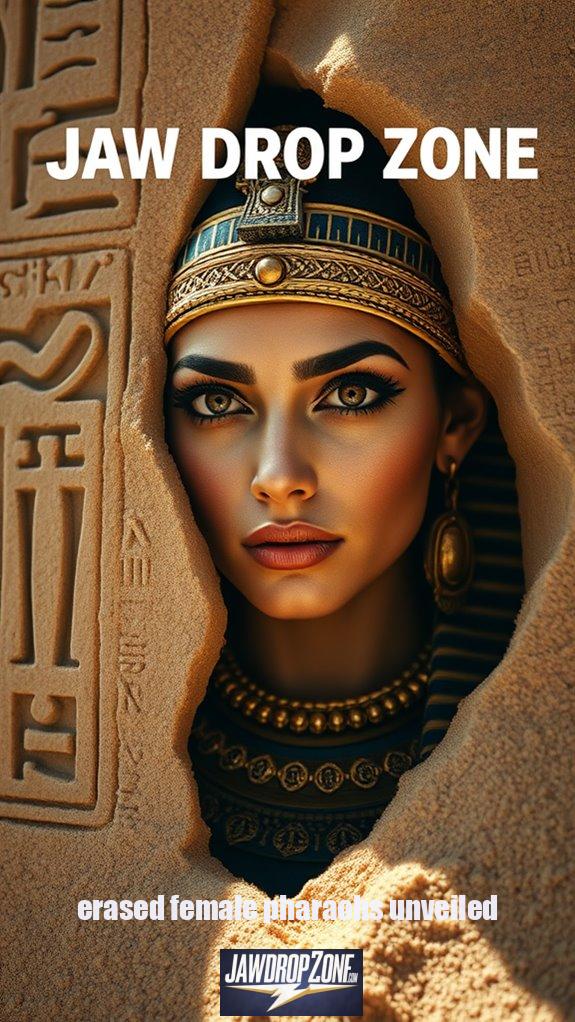
Did you know ancient Egypt had some fierce female pharaohs whose legacies were mostly hidden? It's shocking, but queens like Hatshepsut revitalized trade and built magnificent temples, yet their stories were nearly erased! Envision steering through a male-dominated world while sporting royal regalia—talk about a power move! These queens deserve a spotlight, don't you think? As I created this site, Jaw Drop Zone, to uncover such hidden gems, let's uncover more astonishing tales together!
Quick Takeaways
- Female pharaohs like Merneith and Sobekneferu played crucial roles but are often overlooked in historical narratives.
- Many powerful women rulers faced erasure due to societal biases that favored male leadership.
- Hatshepsut's successful reign exemplifies women's capabilities in governance and economic revitalization in ancient Egypt.
- Rituals and symbols were used by female pharaohs to assert their legitimacy in a patriarchal society.
- Recognizing the contributions of these female rulers enriches our understanding of Egypt's diverse historical landscape.
Female Pharaohs: Unveiling Their Hidden Legacy

Hidden away in the sands of time, Egypt's female pharaohs often get overshadowed by their male counterparts, but their stories are nothing short of extraordinary. Can you envision a time when women wielded power as pharaohs, shaping the course of history?
Take Merneith, for instance, believed to be the first female ruler of Egypt. She's a prime example of how female rulers navigated the complex power dynamics of a male-dominated society. Rituals of legitimacy were often employed to bolster their positions and assert their authority.
Then there's Sobekneferu, the first confirmed female pharaoh, who ruled during the Twelfth Dynasty. She didn't just sit on a throne; she completed her father's pyramid complex—her father's pyramid complex—talk about legacy!
And let's not overlook Nefertiti, whose influence alongside Akhenaten changed religious practices. She wielded her power like a master tactician, all while challenging the status quo.
Women often found themselves in leadership roles when male heirs were absent or during times of crisis. Picture it: a society in turmoil, and a woman steps up, adopting male regalia to assert her legitimacy.
These queens knew how to play the game, using symbols of power to carve their place in history.
But here's the kicker: despite their achievements, many of these powerful women are often erased from the narrative. Why is that? Maybe it's because their stories disrupt the traditional tales we've all been told.
Neglected Legacy of Hatshepsut

While it's easy to overlook the contributions of female rulers in ancient history, Hatshepsut's reign as Pharaoh of Egypt is a startling reminder of what women can accomplish when given the chance.
Her achievements, from the Djeser-Djeseru Temple to revitalizing trade routes, shine bright against historical misrepresentation. Hatshepsut was not only a skilled diplomat but also a master of ancient trade networks, which allowed her to strengthen Egypt's economy and influence.
Isn't it time we celebrated this remarkable woman and reclaimed her rightful place in history?
References
- https://www.historyhit.com/women-who-ruled-ancient-egypt/
- https://www.youtube.com/watch?v=C_tnkvE0TJU
- https://top50women.com/ancient-egypts-top-10-female-pharaohs/
- https://www.theexploresspodcast.com/episodes/2019/5/14/who-runs-the-world-ancient-egypts-female-pharaohs
- https://historycooperative.org/queens-of-egypt/
- https://www.closerlives.com/blog/post/temple-of-hatshepsut-and-the-legacy-of-egypt-s-formidable-female-pharaoh
- https://www.researchhistory.org/2011/04/05/secrets-of-egypts-lost-queen/
- https://our-ancestories.com/blogs/news/the-legacy-of-hatshepsut-of-egypt
- https://www.metmuseum.org/perspectives/hatshepsut-female-pharaoh-egypt
- https://www.chandlerinstitute.org/governancematters/a-3-500-year-old-pharaohs-lessons-for-todays-leaders

