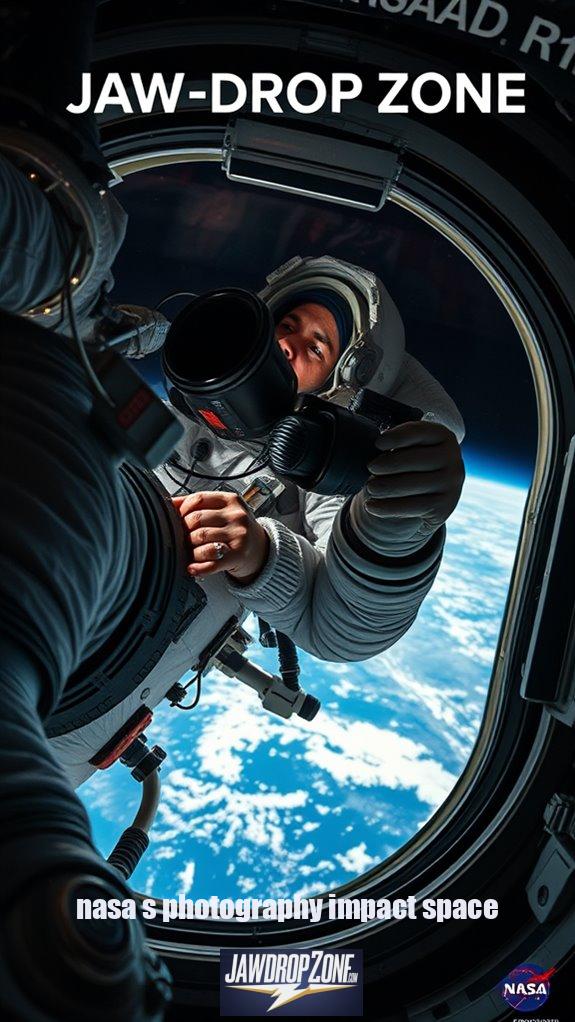
NASA's photography inventions aren't just cool—they changed space history! Recall those tiny CMOS sensors? They took imaging from bulky cameras to sleek devices we love today, like camera phones. With high-res systems, we uncover Earth's secrets like never before. Can you believe that NASA's innovations sparked the selfie craze? It's wild how cosmic breakthroughs hit our everyday lives. If you think that's fascinating, brace yourself for more surprises waiting just below the surface!
Quick Takeaways
- NASA pioneered CMOS image sensor technology, enabling compact and efficient imaging for space missions and beyond.
- High-quality imaging from space facilitated critical documentation and understanding of Earth's environment and land use changes.
- Early large-format cameras captured vital data, accelerating the evolution of photography and enhancing scientific research capabilities.
- Innovations in digital photography, conceptualized by Eugene Lally, set the groundwork for modern imaging techniques and applications.
- The transition of NASA's imaging technology into consumer devices transformed personal photography, reflecting space technology's influence on everyday life.
Innovations in NASA Photography

When you think of NASA, do you picture astronauts floating in space or perhaps awe-inspiring rocket launches? While those images are enchanting, I want to take you on a fascinating journey through the innovations in photography that NASA's Jet Propulsion Laboratory (JPL) tackled. Have you ever marveled at the crisp images captured in space?
It all began back in the 1990s when NASA enhanced the world of photography with complementary metal-oxide semiconductor (CMOS) image sensors. These were no ordinary sensors. The invention of the CMOS active-pixel sensor (CMOS-APS) changed everything. Visualize tiny amplifiers nestled within each pixel, cranking up the electrical output from the light they collected.
It's like having a personal cheerleader in your camera that makes each photo pop with quality while keeping energy consumption low. Because of that, the first commercial use of this technology came from Photobit, established by JPL engineers — talk about a game-changer! The CMOS image sensors developed by NASA became integral to modern photography, leading to the widespread adoption in consumer electronics.
Now, fast forward to the mid-2000s. With these tiny powerhouses, camera phones became your pocket-friendly companions. Isn't it wild how what NASA developed to capture the wonders of the cosmos now fits in your hand, ready to snap that perfectly filtered selfie?
Isn't it fascinating how NASA's cosmic innovations transformed into the camera phones we now use for selfies?
But photography's roots extend much deeper, with pioneers like Joseph Niépce, who clicked the first photograph back in 1826! NASA's early photographers relied on large-format cameras — perfect for those epic shots of Earth from space.
And did you know Eugene Lally, another creative mind at NASA, conceived digital photography by playing around with photo sensors in the '60s?
High-Resolution Image Processing System

Envision gazing at a stunningly detailed image of Earth taken from space, where even the tiniest details pop with vibrant colors and sharp clarity.
With tools like PixelLearn and sophisticated algorithms, NASA's High-Resolution Image Processing Systems empower us to decode our planet's mysteries like never before.
Can you conceive tracking changes in land use or monitoring our environmental health daily? That's right—thanks to satellites like MODIS, we're not just looking; we're understanding.
Isn't it thrilling knowing that every pixel holds the key to scientific discovery? The advancement in imaging technology has parallels to the surviving records of history that unveil stories of the past.
Welcome to Jaw Drop Zone, where we unravel the wonders of our observable universe!
References
- https://spinoff.nasa.gov/Spinoff2010/cg_3.html
- https://www.nasa.gov/wp-content/uploads/static/history/alsj/apollo.photechnqs.pdf
- https://www.nasa.gov/early-years-at-nasa-glenn-a-pictorial-history/
- https://www.shuyiwrites.com/uploads/1/3/0/4/130438914/how_to_write_and_publish_a_scientific_paper.pdf
- https://www.fairlicensing.com/en/blog/when_was_photography_invented_history_of_photography_and_cameras
- https://software.nasa.gov/software/category/data_and_image_processing
- https://www.earthdata.nasa.gov/news/blog/introducing-daily-30m-resolution-imagery
- https://library.fiveable.me/history-of-photography/unit-11/space-exploration-photography/study-guide/2DVRftsUOsaeaG9f
- https://www.earthdata.nasa.gov/learn/earth-observation-data-basics/data-processing-levels