Tag: women empowerment

  • Why Did the Bra Revolutionize Womens Fashion?

    Why Did the Bra Revolutionize Womens Fashion?

    The bra revolutionized women's fashion like a superhero bursting through the confines of a corset! Seriously, can you believe women once fainted from discomfort? With Mary Phelps Jacobs' backless design, we traded suffocating straps for something that celebrated freedom and comfort. Envision being able to strut into the workforce, empowered by your undergarments! Isn't that wild? This shift didn't just alter silhouettes; it changed how women viewed themselves. Want to uncover even more surprising twists in fashion history?

    Quick Takeaways

    • The bra replaced restrictive corsets, promoting comfort and freedom of movement for women in their daily lives.
    • It symbolized women's liberation, enabling them to embrace roles beyond traditional societal expectations and participate in the workforce.
    • The evolution of bra designs introduced body positivity, catering to diverse body types and promoting confidence in women.
    • Bra innovations, like Mary Phelps Jacobs' backless design, paved the way for modern fashion, prioritizing practicality without sacrificing style.
    • The shift towards bras reflected changing perceptions of femininity, allowing women to express their identity and body image choices freely.

    The Bra: A Symbol of Empowerment and Change

    bra as empowerment symbol

    When you think about women's fashion, have you ever paused to wonder about the unsung hero that literally holds it all together? Yeah, I'm talking about the bra!

    Visualize a time when corsets were the norm, dictating not just style but also comfort. Picture women in the Victorian era, laced up to the point of fainting. Oh, the fun of being fashionable, right? The societal pressure to conform mirrored the intensity of the suffragette movement, where women fought to break free from traditional constraints and hunger striking tactics to demand their rights.

    The early 20th century saw a remarkable shift, where discomfort began to lose its charm. Enter Herminie Cadolle with her two-piece undergarment—a refreshing change! Suddenly, women were breaking free from their restrictions, and the bra became a symbol of liberation. This revolutionary change in undergarments influenced the popularity of bra-like garments that traced their roots back to ancient civilizations.

    Can you believe that as society evolved, so did the bra? It heralded a new era of women's independence and gave us a chance to ditch heavily structured garments in favor of more exciting, comfortable fashion choices.

    This newfound freedom directly impacted the women's roles. Envision women entering the workforce, not just to make coffee but also to spark revolutions. The bra made moving around a whole lot easier, empowering women to do more than ever before. It's almost poetic, isn't it? A mere undergarment influencing societal change—who would've thought?

    But the story doesn't end there. The evolution of bras shaped body image, too. With cup sizes and underwires enhancing support, women could now embrace both natural shapes and the allure of curves. Talk about giving us options!

    Now, let's get real. The bra is more than just fabric; it's a cultural icon reflecting changes in women's status. It's diversity and inclusivity stitched right into the seams.

    Mary Phelps Jacobs' Innovative Creation
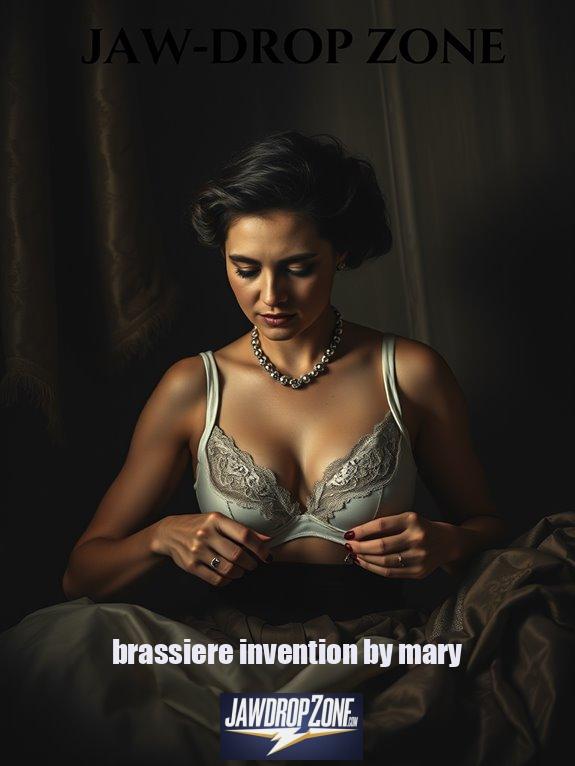
    brassiere invention by mary

    Mary Phelps Jacob didn't just create a bra; she threw the corset off its throne—and trust me, it was about time!

    Picture this: a debutante ball gown, a frantic search for comfort, and voilà—she fashioned a backless brassiere from silk handkerchiefs! Talk about innovation!

    Granted, the first U.S. patent in 1914 was a mere appetizer compared to the multi-million dollar feast that followed.

    Who knew such a simple design would liberate women from those torturous corsets?

    Isn't it ironic? Her genius barely earned her a dime while revolutionizing women's fashion forever.

    Curious about the impact? Immerse yourself with me at Jaw Drop Zone!

    References

  • Empowering Women in Science: Marie Curies Legacy

    Empowering Women in Science: Marie Curies Legacy

    Marie Curie's legacy isn't just about winning Nobel Prizes; it's a dazzling beacon of hope for every aspiring female scientist. Did you know only 28% of the global STEM workforce is female? Shocking, right? Curie shattered societal norms, proving women can revolutionize science! Her story inspires countless girls to embrace STEM. I started Jaw Drop Zone to celebrate these incredible contributions. Curious how we can all keep this momentum going for future generations? There's more to explore!

    Quick Takeaways

    • Marie Curie's groundbreaking achievements in radioactivity set a precedent for women pursuing careers in science.
    • Her legacy symbolizes the possibility of overcoming gender-based barriers in scientific fields.
    • Curie's two Nobel Prizes inspire women to break stereotypes and excel in STEM.
    • She serves as a role model, encouraging young girls to aspire to scientific inquiry.
    • Emphasizing Curie's impact fosters a supportive environment for mentorship and women's contributions to STEM.

    Empowering the Next Generation of Female Scientists

    inspiring young female scientists

    Empowering women in science isn't just a noble cause; it's an urgent necessity that demands our immediate attention. Can you believe that only about 28% of the global STEM workforce today is female? It's like trying to find a unicorn in your backyard! The truth is, gender stereotypes deeply embedded in our society continue to deter countless brilliant minds from entering fields where they truly belong.

    Take Marie Skłodowska Curie, for instance. This legendary figure didn't just toe the line; she obliterated it! Winning not one, but two Nobel Prizes, Curie transformed the terrain of science, showing us that women can, and do, conquer the highest echelons of scientific inquiry. Her legacy isn't just about her incredible achievements in radioactivity; it's also a beacon of hope for aspiring female scientists everywhere. Just as women warriors fought alongside their male counterparts in Viking raids, Curie's determination reminds us that gender does not limit capability.

    How empowering it's to realize that she laid a foundation on which we can build a gender-equal future. Recent statistics show that women make up 35% of STEM students in higher education in the UK, highlighting a significant potential for change.

    But let's be real for a moment—without female mentors, many young women are left adrift in an ocean of stereotypes and biases. We need more role models in STEM to inspire the next generation. It's like a secret recipe; you need the right ingredients!

    When I created Jaw Drop Zone, I wanted to highlight these incredible stories. By showcasing women in science, we turn the tides on archaic beliefs that declare chemistry, physics, and engineering as "male domains."

    Now, many organizations are stepping up, promoting female mentorship programs that nurture talents and provide networks for these vibrant thinkers. It's time we abandon the outdated notion that scientific inquiry isn't for women.

    Let's lift each other up and challenge those stereotypes! So, what can you do to support this movement? Start advocating for change, encourage girls to immerse themselves in science, and, who knows? You just might inspire the next Marie Curie!

    Pitchblende's Radiation Isolation

    radioactive mineral containment strategy

    If I told you that pitchblende, the notorious ore that helped reveal the mysteries of radioactivity, isn't just fascinating but also hazardous, would it surprise you?

    This little gem hides serious health hazards.

    Here's what you need to know about radiation shielding:

    1. Alpha Radiation: Paper stops it, so that's a win!
    2. Beta Radiation: Needs thicker materials; hello, science!
    3. Gamma Radiation: This one's a challenge; only dense metals do the trick.

    Interestingly, the construction techniques used during the development of early nuclear science highlight the importance of safely handling materials like pitchblende.

    Don't underestimate pitchblende! It's a fine line between discovery and danger, and I created Jaw Drop Zone to help you navigate that exciting—but risky—journey.

    References

  • Trailblazing Women Who Conquered Everests Peak

    Trailblazing Women Who Conquered Everests Peak

    Did you know Junko Tabei was the first woman to conquer Everest back in 1975? Envision leading an all-female team through an avalanche! Talk about brave! Her ascent challenged the norms of a male-dominated sport, inspiring countless women to take on their own mountains. Fast forward to 2022, when 23% of Everest permits were issued to women. Who says women can't climb? If you think this is fascinating, wait till you discover other incredible female mountaineers!

    Quick Takeaways

    • Junko Tabei was the first woman to reach the summit of Mount Everest on May 16, 1975, inspiring future generations of female climbers.
    • Lhakpa Sherpa holds the record for the most Everest summits by a woman, showcasing female capability in high-altitude climbing.
    • Alison Hargreaves broke gender barriers in mountaineering, demonstrating women's strength and determination in a male-dominated sport.
    • Wanda Rutkiewicz made significant contributions to women's mountaineering, challenging stereotypes through her achievements in the Himalayas.
    • The American Women's Himalayan Expedition in 1978, led by Arlene Blum, successfully ascended Annapurna, paving the way for future female climbers.

    Trailblazers of Female Climbing History

    women pioneers in climbing

    When I think about the towering peak of Mount Everest, my mind races to the courageous women who dared to etch their names into climbing history. Take Junko Tabei, for instance. She wasn't just the first woman to conquer Everest in 1975; she led an all-female team through an avalanche at 6,300 meters. Talk about raising the bar! Tabei's triumphant ascent on May 16, 1975, didn't just go down in the record books; it ignited a fire within countless women worldwide to take on the mountains themselves.

    Over 900 women have followed in Tabei's footsteps since then, defying societal perceptions that once shackled them with beliefs about women's supposed limitations in adventure sports. Isn't it astonishing how a single act of courage can ripple through time and inspire others to shatter those outdated views? Tabei didn't just summit a peak; she transformed the narrative around female climbing achievements forever. In 2022, 23% of Everest permits issued were requested by women, highlighting a growing interest in high-altitude climbing. This surge in female climbers can be linked to women's participation in scientific expeditions that have paved the way for larger representation in the outdoors.

    Yet, it wasn't all smooth sailing. Along their journeys, many female climbers have faced fierce challenges, from climbing sponsors who believed women were simply too fragile for such pursuits to physical obstacles like altitude sickness. The mountains are unforgiving, and people can be just as brutal—how ridiculous is it that women in the past had to fight for respect in a sport that thrives on resilience?

    Fortunately, for every naysayer, there's a Tabei, a Wanda Rutkiewicz, or an Alison Hargreaves who pushes boundaries and proves doubters wrong. And let's not forget Lhakpa Sherpa, who holds the record for the most Everest summits by a woman. Each ascent isn't just about reaching the top; it's a loud proclamation that women's climbing capabilities are no joke.

    I created this website, Jaw Drop Zone, to guarantee their stories continue to inspire, reminding us all that the only real limits are the ones we impose on ourselves. We've got mountains to climb, literally and figuratively!

    Himalayan Female Mountaineering Pioneers

    himalayan women mountaineering pioneers

    As the winds howl across the majestic peaks of the Himalayas, one can't help but envision the brave women who blazed trails on these formidable mountains.

    Consider the American Women's Himalayan Expedition in 1978; led by Arlene Blum, they conquered Annapurna, shattering gender barriers while daringly facing its perilous terrain.

    Picture selling T-shirts proclaiming "A Woman's Place is on Top" just to fund pioneering expeditions!

    Then there's Junko Tabei, the first woman on Everest—a game-changer.

    These female mountaineering pioneers didn't just climb; they redefined what's possible. In particular, the emergence of Himalayan female Sherpas has opened new avenues for women in high-altitude climbing.

    Isn't it time we celebrated their legacies? Trust me, the narrative deserves a deeper look!

    References

  • Women Who Redefined Fashions Limits Throughout History

    Women Who Redefined Fashions Limits Throughout History

    Have you ever wondered who broke the fashion mold? Meet Coco Chanel, who swapped constricting corsets for the chic little black dress, redefining elegance. Then there's Vivienne Westwood, igniting the punk movement that screamed individuality. Don't forget Diane von Furstenberg's empowering wrap dress, a staple for confidence. And let's not overlook Mary Quant's jaw-dropping miniskirt, the heartbeat of 1960s youth culture. Trust me, the stories behind these trendsetters are just as fabulous, and I promise you won't want to miss out!

    My Quick Strategies

    • Coco Chanel liberated women from corsets, creating the little black dress and revolutionizing casual wear for greater freedom in fashion.
    • Vivienne Westwood introduced punk aesthetics, challenging traditional fashion norms and promoting individuality and self-expression through bold designs.
    • Diane von Furstenberg's wrap dress symbolized women's empowerment, merging practicality and elegance while advocating for women's rights in fashion.
    • Mary Quant popularized the miniskirt, capturing the spirit of youth culture and encouraging women to embrace bold fashion choices during the 1960s.
    • These fashion pioneers sparked movements that redefined societal norms, showcasing the vital role of women in shaping fashion history.

    Celebrating Women Who Changed Fashion Forever

    influential women in fashion

    When you think of fashion, what comes to mind? Maybe it's the glitz of red carpets or the latest trends flaunted on social media. But dive deeper, and you'll discover the real revolutionaries behind today's style icons. Women have redefined fashion's limits throughout history, and their stories are nothing short of inspiring.

    Take Coco Chanel, for instance. She didn't just create the little black dress; she liberated women from the suffocating corsets of her time. Envision strutting down the street, feeling the breeze on your skin instead of being constricted by fabric. That's fashion evolution at its finest! Recent music releases showcase how creativity transcends various forms of expression, much like fashion.

    Then there's Vivienne Westwood, who stormed the fashion scene with her punk-inspired designs. Her boldness challenged traditional aesthetics and made individuality a statement. Who needs rules when you can wear a declaration?

    Let's not forget Diane von Furstenberg, whose wrap dress became a symbol of empowerment. It's practical yet elegant—a true reflection of the idea that comfort can be chic.

    And Mary Quant? She popularized the miniskirt, embodying the spirit of 1960s youth culture and freedom.

    These women didn't just design clothes; they sparked movements. Fashion isn't just about what you wear; it's about expressing who you are, and these pioneers understood that.

    As I created this website, Jaw Drop Zone, I wanted to highlight these incredible women and their impact on fashion.

    References